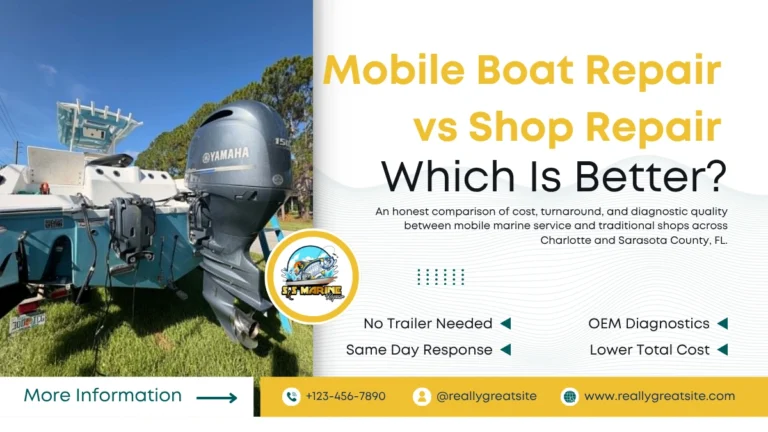

Every boat owner in Punta Gorda has lived through this. It is 6:00 AM, the sun is coming up over Charlotte Harbor, your fishing buddies are standing on the dock with coolers, and the engine turns the key and does nothing. Or clicks and stops. Or cranks forever without catching. The weekend you have been looking forward to is suddenly a service problem, and the shop is six weeks out.
The good news is that a no-start at the dock is almost always a solvable problem the same day. The vast majority of boat engines that will not start on a given morning have faults that a mobile marine mechanic diagnoses in under an hour and resolves on the first visit. The key is calling the right mechanic, with the right tools, at the right stage of the problem, instead of letting it sit for weeks hoping the shop queue opens up.
At S&S Marine Repair we run dockside no-start calls across Punta Gorda constantly, from Fishermen’s Village to Laishley Park to Safe Harbor Burnt Store to the private canals of Punta Gorda Isles and Burnt Store Isles. This guide covers exactly what a mobile marine mechanic does when the call comes in: the diagnostic order we follow, the specific tools we bring, the common causes we rule out at the dock, when the problem genuinely requires a shop, and the typical workflow from arrival to resolution.
Why dockside no-start diagnosis works
A boat that will not start is a particularly good match for mobile diagnosis for a specific reason: the fault is already present at the dock. There is no risk that the problem will fail to reproduce in the diagnostic environment. The engine is right there, in the water, in exactly the condition that produced the no-start, and the mechanic can check every system in real time.
That is different from an intermittent fault that comes and goes, where diagnosing it may require conditions that only exist out on the water or at specific temperatures. A dead no-start, by contrast, is the easiest diagnostic scenario to work. Everything the mechanic needs to see is right in front of him.
The second reason mobile wins for no-start situations is urgency. Shop diagnosis typically requires trailering or transporting the boat (which most Punta Gorda boats are not sitting on trailers), then waiting in a queue, then getting the diagnostic weeks later. Mobile diagnosis arrives the same day or next day for most calls, and the boat goes back to being useful immediately. For a scheduled fishing trip or charter day, that distinction is the whole ball game.
The structural economics of mobile versus shop are covered in more detail in our guide to mobile boat repair vs shop repair. For no-start work specifically, mobile is almost always the correct answer.
What the mobile mechanic brings to the dock
A proper mobile marine no-start service truck arrives with the complete tool set to diagnose and often resolve the fault in a single visit. The essential equipment includes:
OEM diagnostic tools for every major brand: Yamaha CDS, Mercury G3, Suzuki SDS, Honda MECS, and Tohatsu diagnostic software with the correct interface cables. These are what read the ECM for stored fault codes, live sensor data, and running history.
Full electrical test equipment: Digital multimeter, load tester, voltage drop test setup, battery conductance tester. These isolate the vast majority of no-start electrical faults within minutes.
Compression tester: For verifying mechanical health when upstream systems check out.
Fuel pressure test gauges: For verifying fuel delivery across the full pressure range the engine expects.
Common consumable parts in inventory: Battery cables, battery terminals, fuses, common relays, kill switch assemblies, basic ignition components for the major brands, dielectric grease, standard spark plugs for popular engines. A well-stocked mobile truck resolves many no-start calls on the first visit without a parts order.
Service documentation. Factory service manuals and technical bulletins for every brand serviced. These are what turn a vague “it won’t start” into a specific procedural diagnosis.
The combination lets the technician walk from the truck to the dock with everything needed to find and fix a typical no-start. The S&S Marine Repair truck covers all five major outboard brands plus general marine systems. For engine-specific service details see our outboard motor and engine repair and marine engine diagnostics coverage.
The dockside no-start diagnostic sequence
A proper no-start diagnosis follows a specific order. The mechanic rules out the most common and simplest causes first, moves to more complex items as needed, and typically finds the fault within the first 30 to 45 minutes. Here is the actual sequence.
Step 1: Confirm symptom and exclude operator error
Before any tools come out, the mechanic verifies exactly what happens when you turn the key. Does the ignition dash come alive? Does the starter engage? Does the engine crank fast, slow, or not at all? Does it catch and die, or never catch at all?
He also verifies the “obvious” items that account for a surprising percentage of calls: kill switch lanyard properly seated, shifter fully in neutral, fuel in the tank, battery switch in the correct position, main breaker not tripped. None of these are embarrassing to find. They happen to experienced boat owners constantly, especially after extended storage or when someone else has been on the boat.
Step 2: Battery and electrical supply verification
The single most common no-start cause on this coast is electrical, and specifically it is corroded battery connections rather than failed batteries themselves. The mechanic:
Measures battery voltage at rest. 12.6 volts or higher indicates a healthy battery; below 12.4 volts indicates partial discharge; below 12.0 volts indicates significant discharge.
Measures battery voltage under cranking load. A healthy battery with good connections should hold above 9.5 volts under cranking. A reading that drops below 9 volts under load indicates either a weak battery or a bad connection somewhere in the starting circuit.
Performs a voltage drop test on each cable connection. This is the test that catches corroded battery terminals, worn cable ends, and bad grounds. Shop diagnostics often miss these because they look at the battery itself rather than the complete circuit under load.
Verifies battery switch and starting circuit integrity.
If the fault is here (and it often is), repair is immediate: clean or replace corroded terminals, replace degraded cables, apply dielectric grease, and the engine starts. This category of repair is among the least expensive dockside work.
Step 3: Starter and starting circuit check
If voltage and connections are good but the starter still does not engage properly:
Starter solenoid test: A failed solenoid produces a single click when the key turns, with no starter motor movement.
Starter motor current draw test: Reveals whether the starter is drawing abnormal current (worn bushings, dragging armature) or no current (open circuit, bad connection).
Ignition switch continuity test: A failed ignition switch produces no response when turned to start position despite good battery voltage.
Neutral safety switch verification: The engine will not start if the shifter position signal does not reach the ECM as “neutral.”
Starter-related repairs are typically a parts replacement item that completes the same visit if the component is in stock on the truck.
Step 4: Fuel delivery verification
If the engine cranks but does not catch, the diagnostic moves to fuel:
Fuel bulb firmness check (on engines with manual priming): A soft bulb that will not firm up indicates air in the fuel system, a leak, or a fuel supply problem.
Primary fuel filter inspection: Water in the bowl, excessive debris, or signs of ethanol phase separation all point to fuel contamination.
On-engine fuel filter inspection. Second-stage filter condition.
Fuel pressure test: The mechanic connects a pressure gauge to the fuel rail and verifies that cranking the engine produces the correct pressure (typically 40 to 60 PSI on modern EFI outboards, with specific values varying by brand and model).
VST level and condition check on EFI engines.
Fuel sample inspection: A sample from the water-separating filter bowl reveals contamination that may not have reached the engine yet.
Fuel pump function test: If pressure is low, the pump is suspect. If pressure is zero, there is likely either a complete pump failure or an upstream flow problem.
Fuel delivery repairs range widely depending on which component is at fault. Filter replacement is near the cheap end; full fuel pump replacement sits at the more involved end.
Step 5: Ignition and spark verification
If fuel is present and pressure is correct but the engine still will not catch:
- Spark test on each cylinder: Modern inline spark testers verify that each cylinder is receiving adequate ignition energy.
- Spark plug inspection: Fouling, carbon deposits, oil contamination, or electrode wear all affect spark quality.
- Coil output verification: Weak coils produce weak spark that may not ignite the mixture under starting conditions.
ECM diagnostic scan for ignition-related fault codes.
Ignition repairs range from inexpensive (spark plug replacement) to moderate (coil replacement) depending on which component has failed.
Step 6: Mechanical health check
If fuel and spark are both verified good but the engine still does not catch:
Compression test on each cylinder. Low compression on one or more cylinders indicates mechanical issues (worn valves, worn rings, head gasket leak) that need internal work.
Leakdown test if compression is low. Isolates whether the leak is at valves, rings, or head gasket.
Timing verification where applicable. Timing chain or belt wear changes valve timing.
Mechanical repairs at this level are the most significant repair category and the one most worth preventing with disciplined scheduled maintenance. For brand-specific common issues at this level, our guide to common Yamaha outboard problems and how long they last covers Yamaha-specific patterns.
Step 7: Full ECM diagnostic review
Running throughout the diagnosis (not just at the end), the OEM ECM scan reveals stored fault codes, long-term fuel trim data, misfire counts, and sensor outputs that confirm or refine the diagnostic path. On modern EFI outboards the ECM frequently points directly to the fault within the first 10 minutes of scan time.
Common Punta Gorda no-start causes in order of frequency
Across the actual no-start calls S&S Marine Repair runs in Punta Gorda, these are the causes in order of frequency.
1. Corroded battery cable ends (most common): The copper crimp inside the ring terminal turns green and stops passing current. Battery reads 12.6 volts on a meter but delivers only a fraction under load. Fix: clean or replace cable ends, dielectric grease, done.
2. Dead or weak battery: Simple end-of-life, or discharge from accessory drain, or physical damage. Fix: replacement with a correctly-sized marine battery.
3. Kill switch lanyard not seated: Not a repair, just verification. Common on boats where multiple people drive, or after storage.
4. Shifter not fully in neutral: Not a repair, just verification. Common after shifter cable adjustments or on older boats.
5. Fuel contamination (water or phase separation): The boat sat with E10 pump gas long enough for the ethanol to pull in moisture and separate. Fix: fuel system drain, filter replacement, tank treatment.
6. Blown main fuse or tripped breaker: Often a symptom of an underlying short rather than a standalone problem. Fix: identify and repair the underlying fault, replace fuse.
7. Failed ignition switch or kill switch contacts: Switch internal contacts fail from salt corrosion. Fix: switch replacement.
8. Fouled or degraded spark plugs: After extended storage, plugs accumulate corrosion or fouling. Fix: new plugs to exact OEM specification.
9. Failed starter solenoid: Solenoid internals fail from vibration and corrosion. Fix: solenoid replacement.
10. Failed fuel pump: Low pressure or no pressure due to pump wear or failure. Fix: pump replacement.
Note that the top five of these resolve on the first visit with on-truck parts and basic tools. The lower-frequency causes typically also resolve on the first visit but may require a parts order on uncommon items.
Why Punta Gorda conditions produce no-start problems
Several conditions specific to Punta Gorda and the surrounding Charlotte County water accelerate no-start fault development.
Year-round saltwater exposure: No winter break means salt is depositing continuously on every electrical connection, inside every cable crimp, and across every ground point. Over a few years, this is what corrodes battery terminals and harness connectors into no-start failures.
Humidity and summer heat: Ambient conditions accelerate corrosion. The combination of 90-degree air, 90-degree water, and salt mist creates a corrosion environment harsher than almost anywhere else in the country.
Extended storage between uses: Snowbird-pattern ownership (where the boat sits for weeks or months between uses) causes fuel to go bad, batteries to discharge, and connections to oxidize undisturbed. Boats that are run weekly rarely encounter the specific storage-based no-start failures.
Ethanol pump gas: E10 at the fuel dock is unavoidable at most Punta Gorda marinas. Phase separation during storage is the dominant fuel-related no-start cause. Non-ethanol fuel (available at Fishermen’s Village among other local sources) significantly reduces this risk. For a full breakdown of local fuel options and marina services, see our complete Punta Gorda marina guide.
Fiberglass boat canal environments: Boats stored on lifts over seawall canals are exposed continuously to the saline atmosphere, even when not in the water. This matters particularly for electrical connections exposed to the air.
What these no-start repairs typically cost
No-start repair cost depends heavily on which specific component failed. Simple terminal cleaning and dielectric service sits at the very cheap end. Battery replacement, cable replacement, and spark plug replacement are inexpensive routine work. Starter solenoids, ignition switches, and primary fuel filters are moderate parts replacements. Full fuel pump replacement and major fuel contamination service are the more involved items in the typical no-start workflow.
For honest 2026 ranges across every outboard repair category, including the specific no-start repairs covered in this guide, our complete guide to outboard repair costs in Charlotte and Sarasota County breaks down pricing by horsepower, brand, and service type. Diagnostic fees, labor rates, and parts pricing all sit in that guide for ready reference.
What you can safely check before calling
If you want to try the simplest items yourself before calling for mobile service, these are safe to check without special tools.
Kill switch lanyard: Confirm it is fully seated in the ignition panel. Pull it out and reseat it to be sure.
Shifter position: Confirm it is fully in neutral. Wiggle it to verify.
Battery switch: Confirm it is in the correct position (both batteries on, or at least the engine battery on).
Main breaker and visible fuses: Confirm nothing is tripped or blown.
Fuel level: Confirm there is actually fuel in the tank.
Battery terminal condition: Visually inspect for green corrosion. If you see it, do not try to clean it yourself if you have no experience; call for service.
Primary fuel filter bowl: On most boats, the water-separating filter has a clear bowl you can inspect without tools. If you see water or debris in the bowl, that may be the fault.
Beyond these items, calling a mobile mechanic is the right move. Attempting electrical diagnosis without proper tools, or opening fuel system components without understanding what you are doing, routinely turns small problems into larger ones.
Scheduling mobile marine service in Punta Gorda
S&S Marine Repair runs mobile marine service response across all Punta Gorda marinas (Fishermen’s Village, Laishley Park Municipal Marina, Safe Harbor Burnt Store, Punta Gorda Marina) plus every private residential dock in Punta Gorda Isles, Burnt Store Isles, and the connected canal neighborhoods. Response time is typically same day or next day for most scheduled calls, with same-day availability for genuine emergency breakdowns during peak season.
For the full coverage of our Punta Gorda service area including specific marina access protocols and canal response, see our mobile boat repair in Punta Gorda service area details.
When shop service is genuinely the right answer
For intellectual honesty, a few no-start scenarios genuinely do call for shop service rather than mobile. These are the exceptions, not the rule.
Full internal engine rebuilds: If the no-start traces to severe internal mechanical damage (seized bearings, catastrophic valve damage, major piston failure), the subsequent rebuild work benefits from a shop environment with bench presses, precision machining tools, and extended controlled conditions.
Full-boat electrical rewires: If the no-start is a symptom of comprehensive wiring failure that will require pulling the console and extracting old harnesses, the extended teardown work benefits from a shop bay.
Warranty-covered repairs requiring authorized facility documentation: Some brand warranties specify that certain covered repairs occur at authorized dealer facilities.
For every other no-start cause, mobile service at your dock is both faster and more cost-effective. The full tradeoff analysis is in the comparison guide linked earlier.
Frequently asked questions
Can a mobile marine mechanic diagnose any boat engine problem at my Punta Gorda dock?
Yes, for the vast majority of problems. The specific exceptions are major internal engine rebuilds requiring bench press and precision machining equipment, which benefit from a shop environment even though diagnostic and parts coordination still happens mobile. Everything else, including virtually all no-start causes, happens at your dock.
How quickly can a mobile mechanic come to my Punta Gorda dock?
S&S Marine Repair runs same-day availability for genuine emergencies and next-day scheduling for most scheduled calls across the Punta Gorda area. Peak season (April through October) adds a day or two but response times remain dramatically better than typical shop queue times.
How much does mobile no-start diagnosis cost?
A proper mobile no-start diagnostic covers battery and electrical testing, fuel pressure testing, an OEM ECM scan, and visual inspection. The diagnostic fee is typically deducted from the repair invoice if you authorize the repair on the same visit, which effectively makes the diagnostic free once you proceed with the fix. For current ranges across Charlotte and Sarasota County, see our cost guide.
Can mobile mechanics replace batteries and cables on site?
Yes. Battery replacement, cable replacement, terminal cleaning, and dielectric grease service all happen at your dock. S&S Marine Repair carries common marine battery sizes and cable stock in the service truck. Our mobile boat electrical service covers all dockside electrical work.
What should I do if my boat will not start at the dock in Punta Gorda?
Verify the simple items (kill switch, shifter in neutral, battery switch, fuel level, visible fuses). If those check out, call for a mobile diagnostic rather than running the starter continuously. Continued cranking on an unresolved fault risks damaging the starter and draining the battery further.
Does S&S Marine Repair service all outboard brands?
Yes. S&S Marine Repair services Yamaha, Mercury, Suzuki, Honda Marine, and Tohatsu outboards at your dock with the correct OEM diagnostic tools and parts sourcing for each brand. Each brand has dedicated service pages including Yamaha outboard repair and service covering the specifics.
What if my boat is stored at a marina with restricted access?
S&S Marine Repair coordinates access with every marina in Punta Gorda including Fishermen’s Village and Laishley Park Municipal Marina. Access arrangements are made in advance of the service visit, and the technician works at your slip within the marina’s standard visitor protocol.
Can you handle no-start problems on older carbureted outboards?
Yes. While modern EFI outboards are the majority of the fleet, carbureted platforms are still common on smaller skiffs and older bay boats in the Punta Gorda area. The diagnostic approach differs (no ECM scan, more hands-on carb inspection) but the mobile service covers both.
Will mobile service work if I am not available to be at the dock?
Yes, provided access to the boat is arranged in advance. Many owners authorize work by phone after a verbal diagnostic from the technician, with the completed work and written invoice reviewed afterward. This is particularly useful for owners who travel or have conflicting schedules.
How often do no-start problems resolve on the first visit?
The majority of mobile no-start calls resolve on the first visit with on-truck parts and basic tools, especially the common electrical and battery-related faults that dominate the local service pattern. Faults requiring a specific parts order resolve on a follow-up visit, typically within a short lead time depending on part availability.
Ready to get your boat starting again
If your boat is not starting at your Punta Gorda dock, the fastest path to a working engine is a mobile diagnostic from a certified mobile marine mechanic who can arrive the same day or next day with the full tool kit to find and fix the fault on site. S&S Marine Repair runs mobile marine service across every Punta Gorda marina and residential dock, with coverage across the whole corridor from Charlotte Harbor to Boca Grande.
The fastest way to describe a no-start to S&S Marine Repair is one sentence of exact symptoms: does the key produce a click, a crank-but-no-catch, or no response at all. Add your boat make, engine model and year, and we can usually tell you on the phone whether we have the needed part on the truck. Text or call (239) 333-6722, or book a mobile boat mechanic through the request form, and we will confirm an arrival window at your Punta Gorda dock. The boat does not need to move, and the vast majority of no-start calls resolve on the first visit.