Mobile Boat Electrical Service in North Port, Charlotte & Sarasota County, FL
Battery installs, wiring troubleshooting, bilge pump repair, lighting, gauges, ignition, and complete boat rewiring handled at your slip, boat lift, or driveway. Marine-grade tinned wire, sealed connections, and ABYC-standard installation on every job.
Marine Electrical Work Delivered to Your Dock
Saltwater and 12-volt wiring do not get along. Corroded connectors, dead batteries, blown fuses, half-working accessories, and mystery drains that leave the boat unable to start are the daily reality of owning a boat on the Gulf Coast. Marine electrical problems compound over time because the same conditions that caused the first fault (salt air, humidity, vibration) continue to cause the next one on the same connectors and wire runs. Left unaddressed, small electrical issues turn into whole-system reliability problems.
S&S Marine Repair handles mobile boat electrical service across Charlotte and Sarasota County. Owner and technician Spencer Iannuzzi diagnoses and repairs electrical problems at your boat, not in a shop. From a single dead battery to a full boat rewire, we bring marine-grade materials, diagnostic tools, and the equipment needed to complete most electrical work in a single visit. No shop trip, no trailer required, and no need to wait weeks in a repair queue.
Trusted by Boat Owners Across Southwest Florida
About Our Approach to Marine Electrical Repair
S&S Marine Repair is a family-owned mobile marine service based in North Port, Florida. Owner and technician Spencer Iannuzzi handles the electrical work personally, using marine-grade tinned wire, sealed connections, and ABYC-standard installation practices on every job. When you book electrical work, the person who diagnosed the fault is the same person who does the repair.
Our approach to boat electrical work is disciplined: diagnose the actual fault before replacing anything, use marine-grade materials specifically because household or automotive materials fail in salt air, follow ABYC standards for wire gauge, circuit protection, and connection quality, and document what was done so future service has a clear record. That approach produces electrical systems that stay reliable rather than needing repeated repair.
The Full Range of Boat Electrical Work We Handle
Marine electrical work covers a broad category. Different boats have different systems, different failure modes, and different levels of complexity depending on age and how heavily they have been modified over the years. Our regular scope covers the full range.
Battery Systems and Charging
Battery-related issues are one of the most common electrical calls we handle. Work includes single, dual, and triple bank battery replacement using marine deep-cycle or dual-purpose batteries appropriate to the boat’s use pattern, battery switch, isolator, and combiner installations for proper multi-battery management, onboard marine battery charger installation and wiring, battery drain diagnosis when a fully charged battery goes dead over a few days without use, alternator and stator testing and replacement, and voltage regulator and rectifier repair on both older and newer outboards. Battery problems often reveal upstream faults in the charging system or downstream faults in accessory wiring, and proper diagnosis catches those.
Bilge Pumps, Safety Systems, and Water Management
Bilge pump reliability is a safety issue on any boat kept in the water. Work includes bilge pump repair and replacement, float switch installation and testing, automatic bilge system wiring with proper circuit protection, live-well and bait-well pump installation and repair on fishing boats, and emergency electrical shutoff and kill switch service. On boats used regularly on this coast, bilge system service is not optional maintenance.
Marine Lighting Systems
Marine lighting includes navigation and anchor lights, deck and courtesy lights, cabin and interior lights, and underwater LED accent lighting that has become popular over the last decade. Common lighting work includes navigation and anchor light repair and replacement, deck and step lighting installation, interior cabin lighting service, and underwater LED marine lighting installation with proper marine-grade wiring and sealing.
Instruments, Gauges, and Control Systems
Boat gauges and instruments range from simple analog tachometers and fuel gauges to complex digital multifunction displays on modern boats. Work includes gauge repair and replacement (analog and digital), full instrument panel wiring, trim and tilt gauge diagnostics, fuel sender and tachometer troubleshooting, and digital multifunction display installation on newer boats.
Starting and Ignition Systems
Starting problems are frequently electrical rather than engine-related. Work includes starter motor and solenoid replacement, ignition switch replacement, key switch corrosion and starter circuit repair, and neutral safety switch repair. Many no-crank problems that get misdiagnosed as engine issues turn out to be electrical faults in the starting circuit.
Complete Boat Rewires
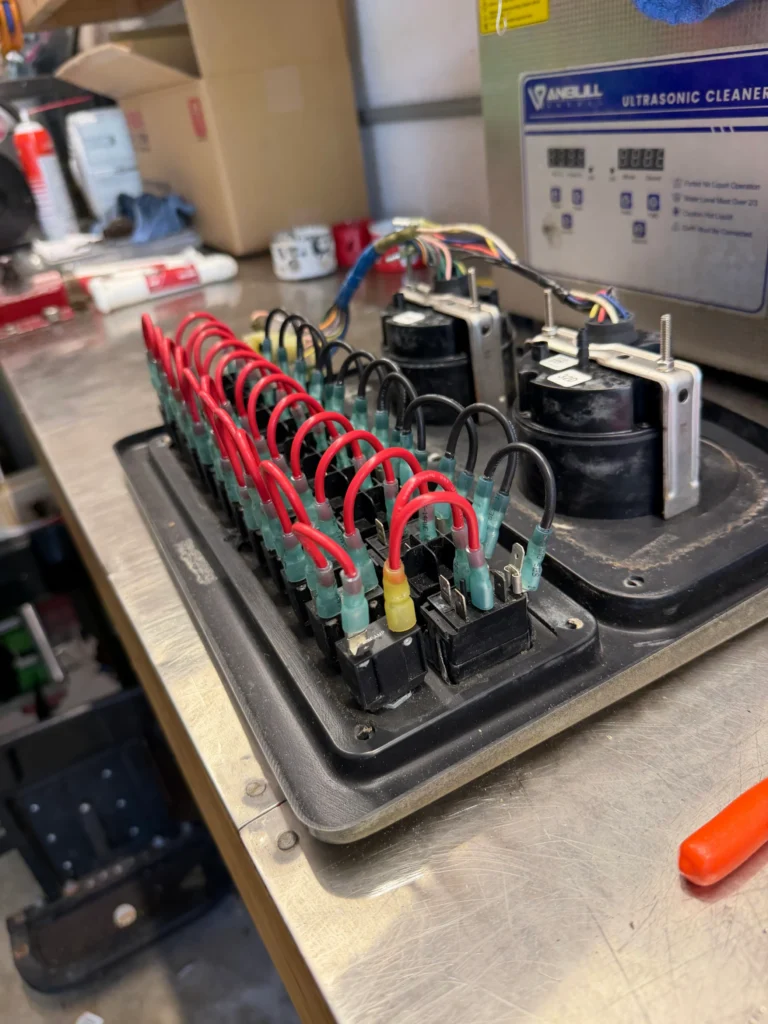
Older boats and boats that have been heavily modified over the years often reach a point where patching the existing wiring is more expensive and less reliable than starting over. A complete boat rewire eliminates a decade of accumulated wiring problems in one pass. Rewire work includes planning the routing and circuit organization, removing old wiring and hardware, installing new marine-grade tinned wire sized for each circuit’s actual load and length, installing a new fuse or breaker panel with clearly labeled circuits, using sealed heat-shrunk connections at every junction, and providing full documentation of the finished layout for future service.
Why Boat Electrical Problems Need a Marine Specialist
Household electricians and even automotive electricians are not trained to work on boats. Boats run mostly 12-volt DC (or 24V and 36V for trolling motor systems) with some 120-volt AC through shore power on larger boats. The wiring standards, corrosion protection requirements, connector types, and safety codes are all different from residential or automotive work. A household electrician working on a boat is likely to use household-grade materials that will fail quickly in a saltwater environment.
The specific requirements for marine electrical work matter for both performance and safety. Marine wiring uses tinned copper conductors because regular copper corrodes quickly in salt air. Marine connections need to be sealed and heat-shrunk because crimp-only connections fail from moisture intrusion. Marine fuses and breakers need to be sized for the actual conductor gauge to protect the wiring from overheating. ABYC standards specify wire color coding, routing, and installation practices that produce safe, reliable systems. Ignoring any of these requirements produces electrical work that looks fine at delivery but fails within months.
How We Diagnose and Repair Boat Electrical Issues On-Site
Marine electrical work benefits from being done at the boat because most electrical faults are easier to diagnose in the boat's normal operating environment than on a shop bench.
-
Symptom Analysis and Initial Diagnostic
You describe what the electrical system is or is not doing. Battery going dead over three days. Bilge pump running constantly. Nav lights not turning on. Charging system reading low voltage. We ask specific questions to narrow the possible causes, quote the diagnostic fee upfront, and schedule the visit. For unusual problems, we discuss what testing approach makes sense.
-
On-Site Testing and Fault Isolation
On arrival, we test the actual electrical system in its normal state. For battery drains, that means measuring parasitic current draw with a clamp meter or in-line ammeter, then pulling fuses one at a time to isolate which circuit is causing the drain. For charging problems, that means testing alternator or stator output under real load. For accessory failures, that means tracing the circuit from the accessory back to the source to find the actual break. Testing the real boat in real conditions catches faults that shop bench testing misses.
-
Repair Using Marine-Grade Materials
Once the fault is identified, we repair using marine-grade tinned wire sized appropriately for the circuit, sealed and heat-shrunk connections, marine-grade connectors and terminals, and properly rated fuses or breakers. We do not use household materials on marine wiring, ever, because they will fail within a few years in salt air even if they work fine at installation.
-
Verification and System Handoff
Once the repair is done, we verify the entire system is working correctly and that the original problem is resolved. For full rewires, we test every circuit before considering the job complete. Documentation of the finished work goes with the invoice so you have a record of what was done for future service reference.
Brands We Service
Marine Brands We Service & Repair
Factory-level diagnostics and repair for the engines, trolling motors, and electronics powering Southwest Florida boats. Tap any brand for model coverage and brand-specific service details.












Common Boat Electrical Service Questions
What is a boat electrician called?
Depending on scope, a marine electrician, marine electronics technician, or marine mechanic. For most 12-volt DC work and accessory installs, a marine mechanic with electrical experience covers it. Complex AC shore power work sometimes calls for a licensed marine electrician certified through ABYC or a similar credentialing body. On this coast, marine mechanics handle the majority of electrical work because engine and electrical systems are so interconnected on modern boats.
Do household electricians work on boats?
Not competently, in most cases. Household electricians are trained on 120/240-volt AC systems installed in fixed buildings. Boats run mostly 12-volt DC with some 120-volt AC through shore power. The wiring standards, corrosion protection, connector types, cable routing requirements, and safety codes are different for marine environments. Boat electrical work should be done by someone who knows marine standards, understands salt corrosion, and uses marine-grade materials. Household electricians working on boats often make things worse rather than better.
How much does it cost to rewire an entire boat?
Full boat rewires vary widely with boat size, wiring complexity, and the state of the existing system when we start. A small center-console with a simple electrical system takes far less time than a heavily rigged fishing boat with dozens of accessory circuits. Every rewire gets a written quote after inspecting the boat and the existing wiring. We do not quote rewires over the phone because condition and scope vary too much for phone estimates to be accurate. Free written estimates after inspection.
How do you find a battery drain?
We measure the parasitic current draw at the battery with a clamp meter or an in-line ammeter, then pull fuses or disconnect circuits one at a time to isolate which circuit is causing the drain. Once we know the circuit, we trace it back to the specific component pulling power when it should not. Common culprits include aftermarket stereos wired with always-on power, corroded bilge pump float switches that never fully shut off, older chartplotters with leaky standby circuits, and marine radios with poorly designed power management. Diagnosing at the dock over a full electrical cycle catches faults that shop testing misses.
What are the three main electrical systems on a boat?
The 12-volt DC system powered by the starting and house batteries handles most of what happens on a typical boat: starting the engine, running gauges, lights, pumps, and accessories. The 120-volt AC system powered from shore power when tied to a dock (on boats with shore power) runs any AC-powered equipment on board. And on larger boats, a 12-volt DC accessory system separate from the starting system, or a small onboard AC generator, handles additional loads. We work on all three systems, though the majority of typical boat electrical work is 12-volt DC.
Can you install a marine stereo?
Yes. Marine stereo installs are one of our regular jobs. We handle the head unit installation, speaker wiring using marine-grade wire, amplifier install if you are running one, and cleanup of the power wiring so it does not add to any existing battery drain problem. Many marine stereo installs we service were originally installed by boat owners or non-marine technicians using automotive-grade materials, which fail quickly in the marine environment. We use marine-grade wire and sealed connections on every install.
Are LED lights worth upgrading to on a boat?
Yes, in most cases. LED marine lights draw a fraction of the current of incandescent bulbs, which reduces battery drain when running lights at anchor or overnight. LED bulbs last significantly longer in saltwater environments because they have fewer failure modes than incandescent filaments. They also run cooler, which matters in enclosed cabin lighting. The one caveat is that some LED navigation lights need a proper marine-grade housing to survive the environment, so cheap LED replacements marketed for automotive use often fail. We recommend marine-specific LED products.
Should I have dual batteries on my boat?
For most boats used regularly on this coast, yes. A dedicated starting battery and a separate house battery with a proper switch or automatic combiner setup means you always have a start battery in reserve, even if the house side goes flat from running accessories at anchor. That is particularly important on boats used for fishing, where you might be running lights, pumps, radios, and chartplotters for hours before you need to start the engine and head home. Dual-battery systems require correct wiring and appropriate switching to work properly, which we handle as part of the install.
Where We Handle Boat Electrical Work
Our mobile boat electrical service coverage spans Charlotte and Sarasota County. Below are the primary areas where we regularly handle electrical work at customer docks, boat lifts, and residential driveways.
Port Charlotte
Electrical service across the Charlotte Harbor waterfront and residential canal system. Common calls include battery drain diagnostics, charging system repair, and lighting installation on regularly used Harbor boats.
View CoveragePunta Gorda
Marine electrical service for boats at Fishermen's Village, Charlotte Harbor marinas, and residential canal docks throughout the peninsula. Regular battery, wiring, and accessory install work handled here.
View CoverageVenice
Electrical service across Venice waterfront homes and Venetian Waterway canals. Common calls include shore power system work, battery replacement, and full boat rewires on older residential canal-kept boats.
View CoverageSouth Venice
Electrical service for residential boat owners, backyard lifts, and boats stored at private canal docks throughout South Venice. Regular battery, wiring, and lighting work from our North Port service base.
View CoverageEnglewood
Marine electrical coverage for Englewood-area residential docks, marinas along Lemon Bay, and boat storage facilities from Manasota Key inland. Full mobile electrical diagnostic and repair capability.
View CoveragePlacida
Electrical service for boat clubs, marinas, and residential owners along Placida Harbor and Gasparilla Sound. Regular fishing-boat electrical work including electronics wiring and battery installs handled here.
View CoverageRotonda West
Electrical service throughout the Rotonda canal system for boats stored on private lifts and canal docks. Common calls include battery replacement, bilge pump repair, and accessory wiring cleanup.
View CoverageCharlotte Harbor
Electrical coverage for owners along the northern Charlotte Harbor shoreline, connecting waterways, and inland residential canals. Common calls include charging system work and full electrical diagnostics.
View CoverageBoca Grande
Marine electrical service to Boca Grande marinas, boat clubs, and private docks along the island. Regular calls handle battery installs, electronics wiring, and pre-tarpon-season electrical verification work.
View CoverageManasota Key
Electrical coverage across the Manasota Key waterfront, private residential docks, and inland canal boat owners. Regular battery, wiring, and lighting work for the area's residential fishing community.
View CoverageBoat Down? We Come to You.
Call or text (239) 333-6722 with your boat make, size, and a description of the electrical issue or install you need. We will schedule the visit and quote the work as fast as possible.