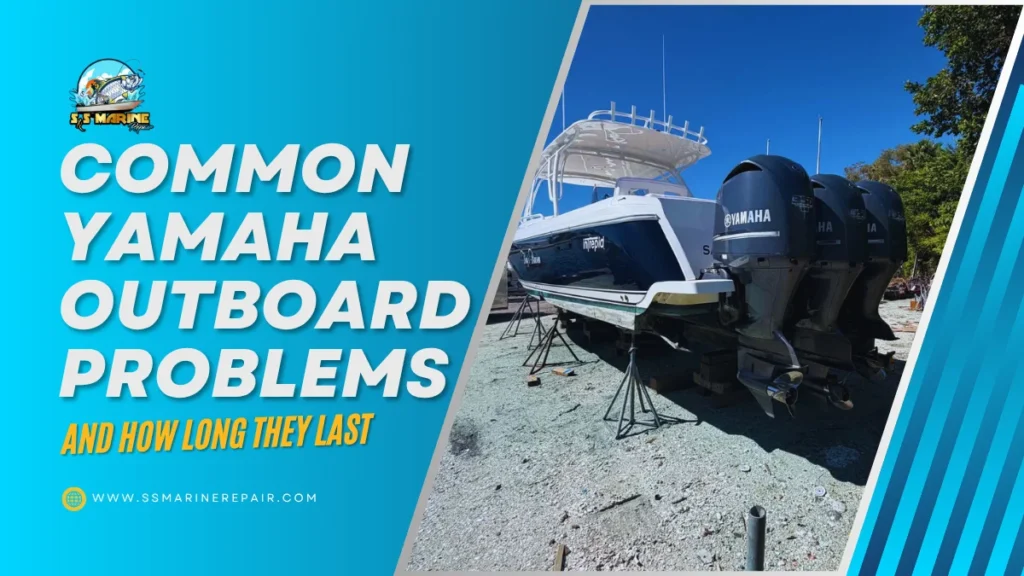
Yamaha is the most common outboard brand in the Charlotte and Sarasota County fleet, and it earned that position honestly. Yamaha engines have some of the strongest long-term reliability records in the industry, the local parts network is excellent, and any competent mobile technician on this coast has serviced hundreds of them. That said, no engine is problem-free. Yamaha outboards have specific known issues that show up predictably in certain models and year ranges, and knowing what to watch for is the difference between catching a $400 preventive service and paying for a $6,000 major repair.
At S&S Marine Repair we service Yamaha outboards every day, from small F70s on skiffs to F425 XTO twins on offshore center consoles, and this guide reflects what we actually see: the specific problems that come in on service invoices, the year ranges where certain issues cluster, the models with the strongest and weakest reliability records, and honest lifespan expectations for well-maintained Yamahas on this coast. Nothing here is bashing Yamaha. Yamaha remains our first recommendation for most local buyers. But every brand has failure modes, and knowing the specific Yamaha failure modes helps you buy smarter, maintain better, and diagnose faster.
Why Yamaha still dominates despite these problems
Before covering the problems, it is worth being clear on why Yamaha remains the default choice for most local owners. The Yamaha reliability record across the F150, F200, F225, F250, F300, and F350 platforms is legitimately excellent. A well-maintained Yamaha routinely reaches 1,800 to 2,200 hours on this coast, and F200 platforms in particular have accumulated a strong track record of 2,500+ hour engines still running cleanly with disciplined service.
The parts network is the strongest in Florida. Common service items are stocked by every mobile technician; even less common parts typically arrive within 1 to 3 business days from Florida distribution. The Yamaha CDS diagnostic system is stable, well-documented, and gives technicians clear fault data. The corrosion engineering is generally very well-executed. And the local technician familiarity with Yamaha is unmatched, which means diagnostic time is shorter and repair paths are well-trodden.
The problems below are real, but they should be read in context. They are the specific issues to know about, not evidence that Yamaha is unreliable. At S&S Marine Repair, Yamaha represents the majority of the outboards we service at dockside slips across Charlotte and Sarasota County, and our Yamaha outboard repair and service coverage handles all of the issues below at your dock.
Problem 1: Midsection and exhaust housing corrosion
Which models and years: Most prevalent on Yamaha F150, F200, and F225 platforms from certain year ranges (particularly 2004 through 2012 F150, though corrosion issues persist to varying degrees across the fleet on undermaintained engines). Newer platforms have improved materials and coatings but the fundamental exhaust housing corrosion mechanism is still present on any Yamaha in year-round saltwater use.
What it looks like: Exterior chalky white deposits and pitting on the exhaust housing and midsection castings, sometimes progressing to visible corrosion holes or thinning. Internal cooling passage scale accumulation is invisible until it affects flow. The engine may run fine externally while internal corrosion silently reduces the wall thickness of exhaust passages.
What is actually happening: Salt water passing through the exhaust cooling passages continuously deposits salt scale. Over years, particularly in engines with inadequate freshwater flushing, the scale accumulates to the point where it accelerates corrosion of the aluminum castings from the inside. Once the corrosion penetrates the exhaust wall, exhaust gases can escape into the cooling water passages, cooling water can leak into exhaust, and the engine develops a cascading set of related failures.
Prevention:
Freshwater flush aggressively after every saltwater use. Ten minutes minimum at operating temperature with full flush port pressure. This single practice is the largest determinant of whether your Yamaha suffers midsection corrosion or does not.
Use Salt-Away or an equivalent freshwater flush additive monthly. This binds to salt crystals and carries them out of the cooling passages before they crystallize and start the scale cycle.
Have the cooling system chemically descaled at 500-hour intervals. This is expensive at that milestone but dramatically cheaper than a midsection replacement.
Inspect anodes at every 100-hour service and replace any that are more than 50 percent consumed. Anodes are the sacrificial protection that keeps the aluminum from corroding first.
Cost when it happens: Midsection replacement on a mid-horsepower Yamaha runs $4,500 to $8,500 depending on horsepower and how much adjacent work is required. The prevented preventive care runs a small fraction of that.
Problem 2: Yamaha F150 specific issues
Which models and years: Yamaha F150 across the platform’s history, with certain generations more affected than others.
The Yamaha F150 is arguably the most popular mid-horsepower outboard in America, and popularity means the failure patterns are documented in detail. Common F150-specific issues include:
Head gasket failures
Certain year ranges of the F150 have shown head gasket vulnerability, particularly on engines that have experienced overheating episodes. Symptoms include coolant loss without visible external leaks, milky oil (oil-water intermixing), and rough running under load. Prevention is straightforward: maintain the cooling system aggressively so overheating episodes never happen. Repair is not simple; a head gasket replacement on an F150 runs $2,500 to $4,500.
Fuel pump degradation
F150 low-pressure fuel pumps have shown wear at higher hours (typically 800 to 1,500 hour range). Symptoms include high-RPM fuel starvation, hard starting after long storage, and hesitation at midrange throttle. Replacement is not complex but costs $800 to $1,500 including labor.
VST filter clogging
The vapor separator tank filter on the F150 is easy to overlook at scheduled service, and once partially clogged produces the classic “runs fine at low RPM, stumbles at high RPM” symptom. VST filter replacement should happen at every 300-hour service; skipping it causes preventable performance issues.
Trim and tilt seal degradation
Common across the F150 platform in coastal saltwater use. Seals eventually leak, the system loses pressure, and the engine will not hold trim under load. Reseal service runs $500 to $900 depending on how much of the system needs work.
For diagnostic work on any of these F150 issues, our marine engine diagnostics service uses the Yamaha CDS software to isolate the specific fault before parts are ordered.
Problem 3: Yamaha F200, F225, and F250 issues
Which models and years: F200, F225, and F250 platforms across the range.
The F200, F225, and F250 platforms are Yamaha’s mid-horsepower workhorses and have earned some of the strongest reliability records in the industry. That said, specific issues cluster around a few known items.
Injector fouling. Yamaha’s fuel injection systems accumulate ethanol-related deposits over time, particularly on engines that run E10 pump gas exclusively without periodic Ring Free or equivalent injector cleaner treatment. Fouled injectors produce inconsistent atomization, rough idle, and midrange stumble. Injector cleaning or replacement service runs $600 to $1,400 depending on how many need attention.
Timing chain guide wear on certain year ranges. The F225 in particular had timing chain guide wear issues on certain generations. Symptoms include unusual noise from the powerhead at idle, sometimes progressing to timing symptoms. Yamaha issued technical service bulletins on this; owners with affected year ranges should ensure the appropriate updates were performed.
Exhaust corrosion (as covered in Problem 1). Particularly prevalent on F225 engines with mixed maintenance history.
Water pump housing degradation. All Yamaha mid-horsepower engines eventually need water pump housing replacement, not just impeller replacement. Housings crack and leak at higher hours. Full housing replacement typically runs $200 to $400 above a standard impeller kit.
Corrosion at the ECU harness plug. Salt intrusion into the main harness plug can produce intermittent electronic faults that are difficult to diagnose because they only manifest under specific conditions. Preventive inspection with dielectric grease refresh at annual service prevents most of these.
Problem 4: Yamaha F300 and F350 issues
Which models and years: F300 and F350 V6 platforms across the range.
The F300 and F350 are the workhorses of the offshore center console fleet on this coast, and their scale and complexity introduces specific higher-cost issues that owners should know about.
Fuel pump assembly failures
The dual fuel pump setup on the F300 and F350 (low-pressure and high-pressure pumps) has shown wear patterns at 1,200+ hours. Replacement of the complete fuel pump assembly runs $1,500 to $2,800 including labor.
Coil pack failures
Individual ignition coils on the V6 platforms occasionally fail, producing a specific cylinder misfire that shows up on ECU diagnostics. Individual coil replacement is $200 to $400 including labor. Failing to replace a bad coil eventually damages the associated cylinder.
Head gasket vulnerability from overheating
As with the F150, any overheating episode on the F300 or F350 creates head gasket risk. Prevention (aggressive cooling system maintenance) matters more than repair here.
Complexity of diagnostics
The F300 and F350 are electronically complex platforms and require Yamaha CDS diagnostic access to properly evaluate fault codes and running data. DIY diagnosis on these engines rarely works well.
Anode consumption rate
The larger engines consume anodes faster than smaller platforms in equivalent conditions. Full anode inspection with replacement of consumed anodes at every 100-hour service is not optional on the F300 and F350.
Problem 5: Yamaha F425 XTO issues
Which models and years: F425 XTO V8 platform, from initial release forward.
The F425 XTO is Yamaha’s flagship large-horsepower outboard and represents the leading edge of the current Yamaha lineup. As with any relatively new platform, the long-term reliability data is still developing, but early indications from the local fleet are generally positive with some specific items to note.
Fuel delivery system complexity
The F425 XTO uses a sophisticated direct-injection fuel system that is more complex than earlier Yamaha platforms. Service on this system requires current Yamaha diagnostic tools and specific procedural knowledge. Not every mobile technician has current XTO training.
Cost of ownership at the flagship level
The F425 XTO commands premium pricing at every level: purchase, scheduled service, and any repair work. Owners should budget accordingly and understand that this is a premium platform with premium service costs.
Anode and cooling system maintenance
The physical scale of the F425 XTO means anodes and cooling passages have proportionally more surface area to protect. Preventive care must scale up accordingly.
Overall reliability trajectory
Early F425 XTO engines are running well and the platform appears solid. As with any newer engine, the true long-term picture develops over the next 5 to 10 years of accumulated hours across the fleet.
Problem 6: Fuel system issues across the Yamaha lineup
Which models and years: All Yamaha four-stroke platforms.
Fuel system issues on Yamahas closely track fuel system issues on all coastal outboards. The specific pattern for Yamaha:
Ethanol phase separation in idle tanks: Any Yamaha that sits weeks between uses on E10 pump gas eventually encounters phase-separated fuel. The result is hard starting, rough running, and injector damage. Prevention (marine ethanol treatment at every fill-up) is critical. This mechanism is covered in depth in our guide to the ten most common outboard motor problems.
Fuel filter neglect: Yamaha service intervals specify fuel filter replacement at every 100-hour service. Skipping this causes preventable performance issues as filters restrict flow.
Fuel line degradation on older engines: Yamaha fuel lines eventually harden and crack in coastal heat exposure. Inspection at annual service catches this before it produces leaks or air intrusion.
Problem 7: Electrical issues across the Yamaha lineup
Which models and years: All Yamaha platforms in year-round saltwater use.
Yamaha electrical issues on this coast almost universally trace to corroded connections rather than component failures. The most common patterns:
Battery cable end corrosion: The single most common no-start cause across the Yamaha fleet. Even under rubber boots, the copper crimp turns green and stops passing current. Prevention: monthly battery terminal inspection, dielectric grease at annual service, cable replacement at any sign of corrosion inside the insulation.
ECU harness plug corrosion: As mentioned in the F200-F250 section, salt intrusion here produces intermittent faults. Annual inspection with dielectric grease refresh prevents most issues.
Gauge and control head corrosion: Yamaha gauges and control heads eventually show corrosion at the connection points. Marine-grade tinned copper connections and dielectric grease at every scheduled service extend the life significantly.
For electrical diagnostics and repairs specifically on Yamaha outboards, our mobile boat electrical service covers dockside voltage-drop testing, connection inspection, and marine-grade repairs using proper tinned copper wire.
How long do Yamaha outboards actually last on this coast?
The honest answer for Yamaha longevity in Charlotte and Sarasota County coastal use, based on the actual engines we see across the corridor:
Well-maintained Yamaha F150, F200, F225, F250: 1,800 to 2,200 hours before major internal work is warranted. Many reach 2,500+ hours with continued disciplined service. F200 platforms in particular have demonstrated exceptional longevity.
Well-maintained Yamaha F300, F350: 1,600 to 2,000 hours before major internal work. The larger engines work harder and reach service milestones proportionally sooner.
Well-maintained Yamaha F425 XTO: Insufficient long-term data yet, but early indications suggest similar 1,500 to 1,900 hour range to major service.
Poorly maintained Yamahas (skipped intervals, no flushing, ethanol fuel abuse): 700 to 1,200 hours before significant repair costs begin. Some reach only 500 to 800 hours before catastrophic failure. The variance in the “poor maintenance” range is enormous because any of the specific problems above can end the engine early.
The single largest determinant of Yamaha longevity is not the specific model or year. It is maintenance discipline. A 2010 F150 with religious maintenance regularly outlasts a 2020 F150 with neglect. The full service interval framework that determines this outcome is covered in our guide to outboard service frequency on the Florida Gulf Coast.
The Yamaha prevention plan
Every problem covered above has a prevention window. Executing the following practices puts your Yamaha on the trajectory of the 2,000+ hour engines rather than the 900-hour failures.
Every trip: Freshwater flush 10 minutes minimum at operating temperature. Verify tell-tale stream at start. Inspect prop for damage or line wraps. Trim down for storage.
Monthly: Battery terminal inspection and cleaning. Dielectric grease refresh on any accessible electrical connections. Full-throttle run to clear carbon accumulation.
Every 100 hours or annually: Full scheduled service including oil, fuel filters, water pump impeller kit, gear lube, spark plugs, anodes, and full inspection. Follow our outboard scheduled hour service program specifications.
Every 300 hours: VST filter, thermostat inspection, expanded fuel system service, complete anode inspection with replacements, comprehensive diagnostic scan for stored fault codes.
Every 500 hours: Water pump housing replacement (not just impeller), cooling system chemical descale, compression test, comprehensive electrical audit, hydraulic trim inspection.
Every 1,000 hours: Full powerhead inspection, timing chain evaluation on applicable models, comprehensive gearcase evaluation, honest assessment of continued repair investment versus repower.
Before hurricane season (June 1 through November 30): Full engine health check, verified electrical connections, current fuel filter, verified anodes. Never optional on this coast.
Pricing for all these service levels tracks the ranges in our full guide to outboard repair costs across Charlotte and Sarasota County. Following this plan on a Yamaha routinely produces a 2,000+ hour engine.
Frequently asked questions
How long do Yamaha outboards actually last?
Well-maintained Yamaha four-strokes routinely reach 1,800 to 2,200 hours on the Florida Gulf Coast before major internal work is warranted, with many exceeding 2,500 hours. F200 platforms in particular have demonstrated exceptional longevity. Poor maintenance cuts this dramatically to 700 to 1,200 hours or less.
What are the most common problems with Yamaha F150 outboards?
Head gasket vulnerability on engines that have overheated, fuel pump degradation at higher hours, VST filter clogging on engines that skip 300-hour service, and trim and tilt seal degradation. All are preventable with disciplined maintenance.
Do Yamaha F250 and F300 outboards have known issues?
Fuel pump assembly failures at 1,200+ hours, occasional coil pack failures on individual cylinders, and head gasket vulnerability from overheating are the primary items. All are manageable with disciplined preventive service and prompt attention to any developing symptoms.
Is Yamaha exhaust corrosion a real problem?
Yes, on certain year ranges of F150 and F225 in particular, and on any Yamaha in year-round saltwater without aggressive freshwater flushing. Prevention (10-minute flushes after every trip, Salt-Away monthly, chemical descale at 500 hours) is highly effective.
How much does it cost to fix common Yamaha outboard problems?
Common issues range from $400 to $700 for VST filter service to $2,500 to $4,500 for head gasket replacement to $4,500 to $8,500 for midsection replacement. Prevention costs a small fraction of any of these. Full pricing sits in our cost guide.
Should I buy a used Yamaha outboard?
If the specific engine has documented service history, has been checked by a competent mechanic, and is priced fairly for its hours, yes. Avoid used Yamahas with no service records, undocumented major repairs, evidence of neglected freshwater flushing (chalky external corrosion, salt residue accumulation), or unexplained recent price drops.
What year Yamaha outboards had the most problems?
Certain 2004-2012 F150 platforms had exhaust corrosion issues that Yamaha addressed in subsequent generations. Certain F225 year ranges had timing chain guide issues that were covered by Yamaha technical bulletins. Newer platforms (2018+) have generally improved materials and reliability, though the fundamental coastal maintenance requirements remain constant.
How can I make my Yamaha outboard last longer?
Aggressive freshwater flushing after every saltwater use, disciplined 100-hour scheduled service, on-schedule 300-hour and 500-hour expanded service, prompt attention to any developing symptoms, and quality fuel with marine ethanol treatment. This combination is what produces 2,000+ hour engines.
Does Yamaha make the most reliable outboard motor?
Yamaha reliability is at the very top of the market and has been for a long time, though Suzuki, Honda Marine, and certain Mercury platforms are competitive. Yamaha’s largest advantage is the parts network and technician familiarity that reduces downtime and diagnostic ambiguity, not necessarily the raw reliability numbers alone. Our full Yamaha vs Suzuki vs Mercury comparison breaks down the honest tradeoffs.
How often should I service my Yamaha outboard?
Every 100 running hours or annually, whichever comes first, for the foundation service. Escalate to expanded scope at 300 hours, 500 hours, and 1,000 hours. Florida coastal use is more demanding than manufacturer specifications assume, so treat the intervals as firm ceilings.
Ready to keep your Yamaha running strong
If you own a Yamaha outboard and want to ensure you are on the right maintenance trajectory, or if you are seeing any of the symptoms covered in this guide, the fastest path to peace of mind is a mobile diagnostic and service quote from a technician who works on Yamahas every day.
Text or call S&S Marine Repair at (239) 333-6722 with your Yamaha model, year, current hours, and any symptoms you have noticed. We service every Yamaha platform from the F70 to the F425 XTO at your dock across the whole corridor from Venice down through Port Charlotte, Punta Gorda, Charlotte Harbor, Englewood, Placida, Rotonda West, Manasota Key, and Boca Grande. For scheduled service or diagnostic work, book a mobile boat mechanic and we will confirm an arrival window at your slip. The boat does not need to move.