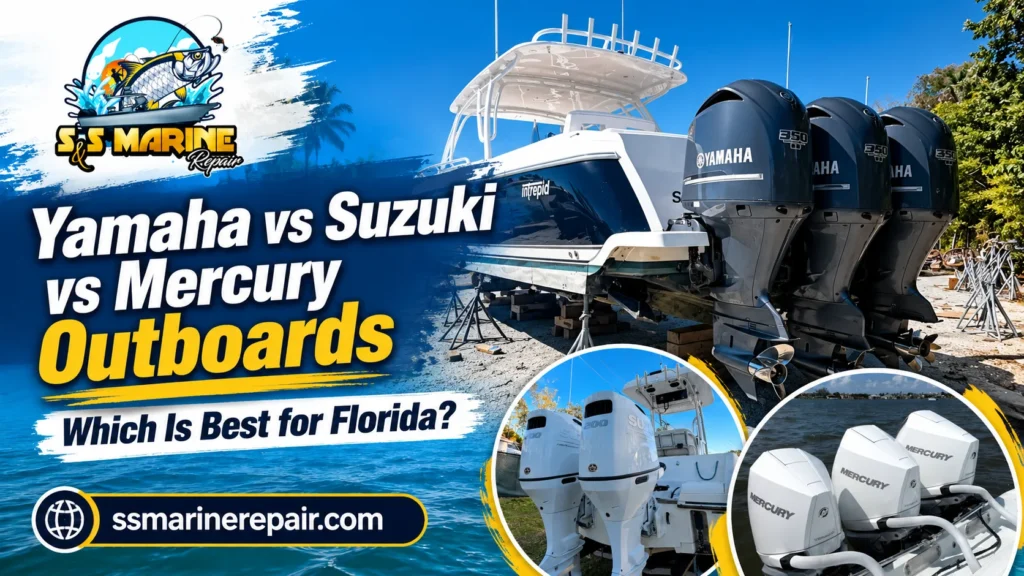
Anyone shopping for a new outboard on the Florida Gulf Coast will eventually come face to face with the big three: Yamaha, Suzuki, and Mercury. All three make genuinely good engines. All three have loyal followings. All three have specific strengths and specific weaknesses that most brand comparisons never get into honestly. And most of what the internet says about this comparison comes from either brand marketing, forum arguments, or bench reviewers who have never actually seen these engines age for a decade in year-round saltwater.
S&S Marine Repair services all three brands (plus Honda Marine and Tohatsu) across the whole Charlotte and Sarasota County corridor, and we see them all at every stage of their life: brand new, mid-life at 400 to 800 hours, high-hour at 1,200+, and the ones that make it to 2,000+ hours in genuinely good shape. That perspective is what this guide brings to the comparison: not marketing, not brand loyalty, honest coastal-mechanic experience with what each brand actually delivers over the long haul.
The short version: all three are legitimate choices, none is objectively best in every category, and the right answer depends on your specific boat, your specific use pattern, and your specific priorities. The long version, with real tradeoffs named openly, follows.
What actually matters when picking an outboard for this coast
Before comparing the three brands, it helps to establish what the actual selection criteria should be. Most outboard comparisons get lost in horsepower ratings, torque curves, and marketing bullet points that do not reflect what matters over the actual life of the engine on the Florida Gulf Coast.
The criteria that genuinely matter over 10 to 15 years of coastal ownership are: corrosion resistance and materials quality, reliability of the specific mechanical and electronic systems, fuel efficiency at cruise (which drives running cost more than initial purchase price), parts availability through Florida distribution networks (which drives repair turnaround time), local technician familiarity with the brand’s diagnostic procedures, warranty terms and coverage, and cost of ownership over the full engine life (initial purchase, routine service, and inevitable major repairs).
Horsepower and top-end speed rarely matter as much as new owners think. Most Florida boats spend the vast majority of running hours at cruise RPM, not wide-open throttle. Fuel efficiency at cruise, reliability at cruise, and cost of ownership at cruise are what actually shape the ownership experience.
Yamaha: the safe default with the deepest local support
Strengths:
Yamaha is the most common outboard brand in the Charlotte and Sarasota County fleet by a comfortable margin, and that fact alone drives several practical advantages. Parts availability through Florida distribution is excellent, common consumables like water pump kits and filters are stocked by most local mobile technicians, and any competent mechanic on this coast has serviced hundreds of Yamahas. When something goes wrong at 800 hours, the diagnostic path is well-trodden and the parts are usually a day or two away.
The Yamaha F150, F200, F225, F250, F300, F350, and F425 XTO platforms are all mature, well-refined engines with genuinely excellent long-term reliability records when properly maintained. The F200 in particular has become the industry benchmark for a mid-horsepower outboard that just keeps running. Yamaha’s ECM diagnostic system (CDS) is stable, well-documented, and gives technicians clear fault code data. The corrosion protection engineering is well-executed.
Weaknesses:
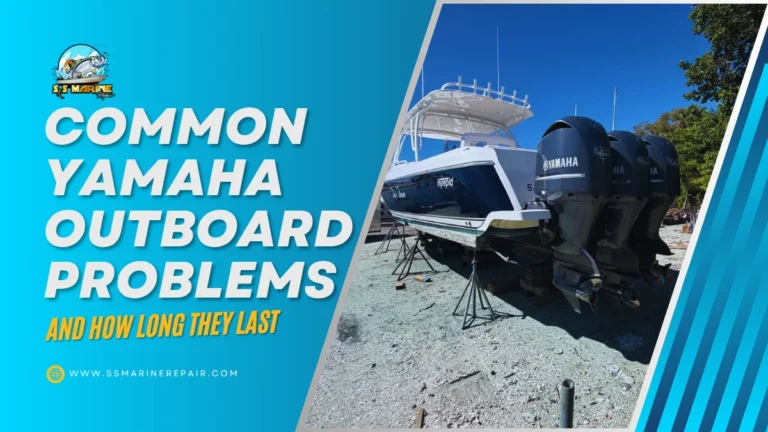
Yamaha exhaust corrosion has been a known issue on certain year ranges of specific models. This is not universal and has been improved on newer platforms, but Yamaha owners with older engines (particularly certain F150 and F225 year ranges) should be aware. This specific issue is covered in depth in our guide to common Yamaha outboard problems and how long they last.
Yamaha midsection corrosion, particularly around exhaust housings and the interface between the powerhead and midsection, becomes a service issue on engines that have not been diligently freshwater flushed. This is preventable but real.
Yamaha’s initial purchase price is at the higher end of the market for equivalent horsepower. You are paying for the brand equity, the parts network, and the reliability track record, but the check is bigger than for a comparable Suzuki.
Best fit: Owners who want the safe, well-supported default with the best local service network. Center console, bay boat, and offshore fishing platform use. Anyone who values easy parts availability and abundant technician familiarity.
Suzuki: the fuel-efficiency and cost-of-ownership leader
Strengths:
Suzuki has arguably the best fuel efficiency in the mid-horsepower outboard market, and this matters more over the ownership life than most buyers appreciate. A modern Suzuki DF250 typically returns 10 to 15 percent better fuel economy at cruise than an equivalent Yamaha or Mercury, which across a 1,500-hour engine life translates to $3,000 to $6,000 in fuel savings at Gulf Coast pricing. That is real money.
Suzuki’s Lean Burn technology and precision fuel injection genuinely deliver on the efficiency claims. The DF140A, DF200A, DF250, DF300, and DF350 platforms have earned strong reliability records over the past decade, and the platform’s design philosophy of maximum mechanical simplicity has aged well. Fewer electronic complications tend to mean fewer failure points.
Initial purchase price is generally 5 to 15 percent below equivalent Yamaha, giving Suzuki the best cost-of-ownership profile among the big three when combined with the fuel efficiency advantage.
Weaknesses:
The local parts network for Suzuki is smaller than Yamaha’s on this coast. Common consumables are fine, but less common parts can occasionally add a business day or two to repair timelines compared to Yamaha work. This is improving but is real.
Suzuki requires disciplined valve clearance adjustment at 300-hour intervals. Owners who skip this cause preventable performance degradation and eventual valve damage. The service itself is not expensive, but it must be done on schedule.
Fewer mobile technicians in some areas specialize in Suzuki compared to Yamaha, which can affect service availability on tight timelines. S&S Marine Repair covers Suzuki fully, and our Suzuki outboard repair and service coverage handles all current Suzuki platforms at your dock.
Best fit: Owners who prioritize fuel efficiency and long-term cost of ownership. Owners running significant annual hours where fuel savings compound meaningfully. Owners who appreciate mechanical simplicity and are disciplined about scheduled service.
Mercury: the performance and technology leader with variable reliability
Strengths:
Mercury has the strongest performance credentials in the outboard market. The Verado platform (particularly the current V8 and V12 configurations) delivers acceleration and top-end that Yamaha and Suzuki simply do not match at equivalent horsepower. For owners running center consoles and offshore boats where performance genuinely matters, Mercury’s Pro XS and Verado platforms are hard to beat.
Mercury’s SmartCraft integration, DTS (Digital Throttle and Shift), and Joystick Piloting for outboards are the most advanced control systems in the industry. For multi-engine setups where docking and low-speed maneuvering matter, Mercury’s joystick integration is genuinely differentiating and years ahead of the alternatives.
Mercury’s parts network in Florida is broad, second only to Yamaha, and the SmartCraft diagnostic system provides technicians with excellent fault data. Our Mercury outboard repair and service coverage handles the full Mercury lineup.
Weaknesses:
Mercury Verado’s belt-driven supercharger is a component the other brands do not have and that adds maintenance complexity. The supercharger belt requires inspection at 300 hours and replacement typically at 1,000 hours, and supercharger service itself is meaningfully more expensive than any equivalent Yamaha or Suzuki service item. Owners of Verados should budget for this.
Mercury’s SmartCraft harness has been a source of intermittent electrical fault complaints in the field. When it works, it is genuinely excellent. When it develops intermittent connection issues (often triggered by corrosion at a specific pin location), it can produce frustrating diagnostic sessions.
Mercury reliability has been genuinely variable across model years. Some year ranges of specific Mercury platforms have earned excellent long-term reliability records. Others have not. The Verado 300 through Verado 400 platforms have generally been strong; certain Pro XS year ranges have earned mixed reputations. Do research on specific model year reliability before committing to a used Mercury.
Best fit: Owners who prioritize peak performance and technology integration. Multi-engine center console owners who want joystick maneuvering. Owners who accept slightly higher maintenance complexity in exchange for the performance and technology advantages.
Head-to-head comparison at a glance
| Criterion | Yamaha | Suzuki | Mercury |
|---|---|---|---|
| Initial purchase price | Higher end | Best value | Middle to high |
| Fuel efficiency at cruise | Very good | Best in class | Good |
| Reliability track record | Excellent | Excellent | Variable by year and model |
| Local parts availability | Best | Good | Very good |
| Local technician familiarity | Best | Good | Very good |
| Diagnostic system quality | Excellent (CDS) | Very good (SDS) | Excellent (SmartCraft) |
| Corrosion protection | Excellent | Excellent | Good |
| Maintenance complexity | Standard | Standard (valve adjustments) | Higher (Verado supercharger) |
| Performance at top-end | Very good | Good | Best in class |
| Multi-engine integration | Good | Good | Best in class (joystick) |
| Warranty (standard, current) | Verify current terms | Often longest coverage | Verify current terms |
| Total 10-year cost of ownership | Middle | Lowest | Highest (Verado); Middle (FourStroke) |
Warranty terms and current promotional offers change constantly, so verify current warranty coverage directly with each brand before purchase. The general rule as of 2026 is that Suzuki has offered some of the longest promotional warranty terms in recent years, though Yamaha and Mercury match this with promotional periods.
Which brand for which use case
Small to mid center console (17 to 24 feet), 150 to 250 horsepower: All three brands are strong here. Yamaha F200 is the safest default. Suzuki DF200A gives best fuel economy and value. Mercury 200 Pro XS gives best performance.
Larger center console (25 to 32 feet), single or twin 250 to 350 horsepower: All three brands strong. Yamaha F300 and F350 dominate the local fleet for good reason. Suzuki DF300 and DF350 are excellent and value-priced. Mercury Verado 300 and Verado 400 deliver best performance and joystick integration for twins.
Large center console (32 to 42 feet), triple 350 or 400 horsepower: Mercury Verado triples with joystick integration is arguably the industry-leading setup for this class. Yamaha F350 triples are the safe, well-supported alternative. Suzuki triples are less common on this coast, though the platform is excellent where it fits.
Bay boat (18 to 24 feet), 150 to 250 horsepower: Yamaha F150 or F200 for the safest default with best local support. Suzuki DF140A or DF200A for best value and fuel economy. Mercury Pro XS for performance-oriented owners.
Flats skiff (16 to 20 feet), 90 to 150 horsepower: Yamaha F90 or F115 for the safest default. Suzuki DF90A or DF115A for best value. Mercury 115 Pro XS for performance-oriented owners.
Offshore sport-fish (30+ feet), twin or triple 350 to 450 horsepower: Yamaha F425 XTO is exceptionally well-regarded for offshore use. Mercury Verado 400 or 450R for performance. Suzuki DF350A is a legitimate contender for owners who prioritize efficiency.
Parts availability and service on this coast
This is where local reality diverges from the marketing brochures. On the Florida Gulf Coast, parts availability by brand runs roughly as follows:
Yamaha: Excellent. Local distribution is strong, common parts are stocked by every reputable mobile technician, and even less common parts typically arrive within 1 to 3 business days.
Mercury: Very good. Distribution is strong, common parts are stocked, and less common parts typically arrive within 2 to 5 business days. Verado supercharger components can occasionally add lead time.
Suzuki: Good. Distribution is capable but slightly less extensive than Yamaha. Common parts are fine; less common items may add 3 to 7 business days.
Honda Marine and Tohatsu (for context): Honda parts are excellent quality with occasional lead time on less common items. Tohatsu parts are affordably priced and generally well-stocked for common items.
For engine-specific service work at your dock, our outboard motor and engine repair coverage handles all three brands plus Honda and Tohatsu. And when something needs proper OEM-level diagnostic work, our marine engine diagnostics service uses the correct OEM tool for each brand.
Cost of ownership over 10 years
The honest 10-year cost of ownership for a mid-horsepower outboard on this coast, assuming disciplined scheduled maintenance and no catastrophic failures, breaks down roughly as follows for the three brands (2026 dollars):
Yamaha F250 or equivalent: Initial purchase $28,000 to $32,000 depending on rigging. 10 years of scheduled service at $500 to $700 per year: $6,000. Estimated additional repairs over 10 years: $2,000 to $4,000. Fuel cost at 1,500 hours over 10 years at average 8 GPH cruise: $60,000 to $70,000. Total 10-year cost: $96,000 to $112,000.
Suzuki DF250 or equivalent: Initial purchase $25,000 to $29,000 depending on rigging. 10 years of scheduled service at $500 to $700 per year: $6,000. Estimated additional repairs over 10 years: $2,000 to $4,000. Fuel cost at 1,500 hours over 10 years at average 7 GPH cruise (efficiency advantage): $52,500 to $61,500. Total 10-year cost: $85,500 to $100,500.
Mercury Verado 300 or equivalent: Initial purchase $27,000 to $31,000 depending on rigging. 10 years of scheduled service at $600 to $850 per year (supercharger service premium): $7,250. Estimated additional repairs over 10 years: $3,000 to $6,000 (higher variance on Verado). Fuel cost at 1,500 hours over 10 years at average 8.5 GPH cruise: $63,750 to $74,250. Total 10-year cost: $101,000 to $118,500.
These are ranges and assume 150 running hours per year, disciplined service, and average local fuel pricing. Individual owner experiences will vary significantly based on use pattern and maintenance discipline. Detailed service and repair pricing sits in our full guide to outboard repair costs in Charlotte and Sarasota County.
Suzuki wins the total 10-year cost comparison at typical use levels. Yamaha wins the risk-adjusted comparison because its lower variance in repair costs and better parts network reduce downtime and uncertainty. Mercury wins in the categories where its strengths matter most (performance, twin/triple integration, joystick maneuvering) at the cost of somewhat higher total ownership expense.
The honest verdict
The honest answer to “which outboard is best for Florida” is that all three are legitimate choices and the right answer depends on what you actually value.
If you want the safest default with the best parts network and technician availability, and you can absorb slightly higher initial cost and fuel cost, pick Yamaha. This is what most owners on this coast pick and it is almost never wrong.
If you want the best cost of ownership over the long haul, best fuel efficiency, and you are disciplined about scheduled service, pick Suzuki. The value proposition is genuinely strong.
If you want peak performance, the best technology and integration for multi-engine setups, or if joystick maneuvering matters to you, pick Mercury. Accept somewhat higher maintenance complexity in exchange for the performance advantages.
Whichever brand you pick, disciplined scheduled service on the interval schedule (100 hours / annual as the foundation, escalating at 300 and 500 hours) is the single largest determinant of engine life. The right maintenance discipline turns any of the big three into a 1,800-hour engine. Poor maintenance turns any of them into a 900-hour engine. The brand matters less than the maintenance.
Frequently asked questions
Which outboard brand lasts longest in Florida saltwater?
Yamaha and Suzuki have the strongest long-term reliability records across the mid-horsepower range, with both routinely reaching 1,800 to 2,000+ hours in coastal use with disciplined maintenance. Mercury Verado has performed well at the high end but with more variance across specific model years. Honda Marine also has an excellent longevity record on this coast, though the network is smaller.
Is Yamaha really that much better than Mercury?
Not universally. Yamaha wins on parts network breadth and local technician familiarity. Mercury wins on peak performance and technology integration. Both are legitimate top-tier choices. Yamaha is the safer default. Mercury is the better choice for specific performance-oriented use cases.
Why is Suzuki cheaper than Yamaha and Mercury?
Suzuki’s manufacturing scale, mechanical design philosophy (fewer electronic complications), and market positioning have supported lower purchase pricing without sacrificing reliability. The tradeoff is a smaller local parts network and dealer footprint compared to Yamaha.
Do all three brands work well in saltwater?
Yes. All three brands engineer specifically for saltwater use with appropriate corrosion protection, anode systems, and materials selection. Yamaha’s corrosion protection is generally considered the strongest, Suzuki is very good, Mercury is good but with more variance across models. Disciplined freshwater flushing after every use matters more than brand choice for long-term corrosion outcomes.
Which brand has the best warranty?
Warranty terms and promotional offers change frequently. As of 2026, Suzuki has often offered the most aggressive promotional warranty terms. Yamaha and Mercury respond with their own promotional periods. Verify current warranty offerings directly with each brand’s dealer before purchase, and read the actual warranty document rather than the marketing summary.
Can S&S Marine Repair service all three brands?
Yes. S&S Marine Repair services Yamaha, Suzuki, Mercury, Honda Marine, and Tohatsu outboards at your dock across the whole Charlotte County and Sarasota County corridor, with the correct OEM diagnostic tools and parts sourcing for each brand.
Should I buy a used outboard from any of these brands?
Any of the three can be a great used purchase if the specific engine has documented service history, is checked by a competent mechanic before purchase, and is priced fairly for its hours. Avoid used engines with no service records, undocumented major repairs, or evidence of neglected freshwater flushing.
What is the best outboard brand for a first-time boat owner in Florida?
Yamaha for the safest default. First-time owners benefit from the largest parts network, the most local technician familiarity, and the well-established service pattern. Yamaha is rarely the wrong answer, and that is a real value for owners who are still learning what they need.
Do I need to match my old outboard brand when replacing?
Not mechanically. All three major brands work with standard rigging harnesses (with brand-specific control and gauge integration). Switching brands typically requires new control heads and gauges, which adds $1,500 to $4,000 to a repower depending on the setup. Staying with the same brand simplifies the swap.
How much difference does maintenance discipline actually make?
Enormous. A Yamaha F250 with disciplined 100-hour service will typically outlast a Mercury Verado 300 with skipped service. And vice versa. Brand is a smaller variable than maintenance discipline across the full life of the engine. Do the service on schedule and any of the three brands rewards you with reliable years of use.
Getting the right advice for your specific situation
Every boat is different, every owner uses their boat differently, and the right outboard for one situation is not necessarily the right outboard for another. If you are shopping for a new outboard or considering a repower, an honest conversation with a mobile mechanic who services all three brands (and does not sell any of them) is the most useful input you can get.
Text or call S&S Marine Repair at (239) 333-6722 with your boat make, model, current engine (if any), typical use pattern, and what you are considering. You will get honest brand recommendations based on what actually works long-term on this coast, not what any dealer has an incentive to push. For scheduled service on an existing outboard of any brand, book a mobile boat mechanic and we will confirm an arrival window at your dock. All three brands, plus Honda Marine and Tohatsu, at your slip.